TL;DR
An immigration attorney recently pointed out a problem every immigration lawyer should notice: a search for a USCIS form surfaced an official-looking result that was not the real USCIS source. That is not only a scam problem. It is a visibility lesson. AI search and modern search results do not simply ask "who has real authority." They depend on what can be found, read, connected, and displayed. That is why an unofficial source can appear where a client expects the official one, and why a competitor with clearer public signals can sometimes be easier for AI systems to describe than a stronger attorney with a weaker public footprint. The point is not to game search. The point is to make the true source easier to recognize. For USCIS, that protects clients. For attorneys, it protects real expertise from being missed, misread, or replaced by a cleaner-looking signal.
The problem is bigger than one bad result
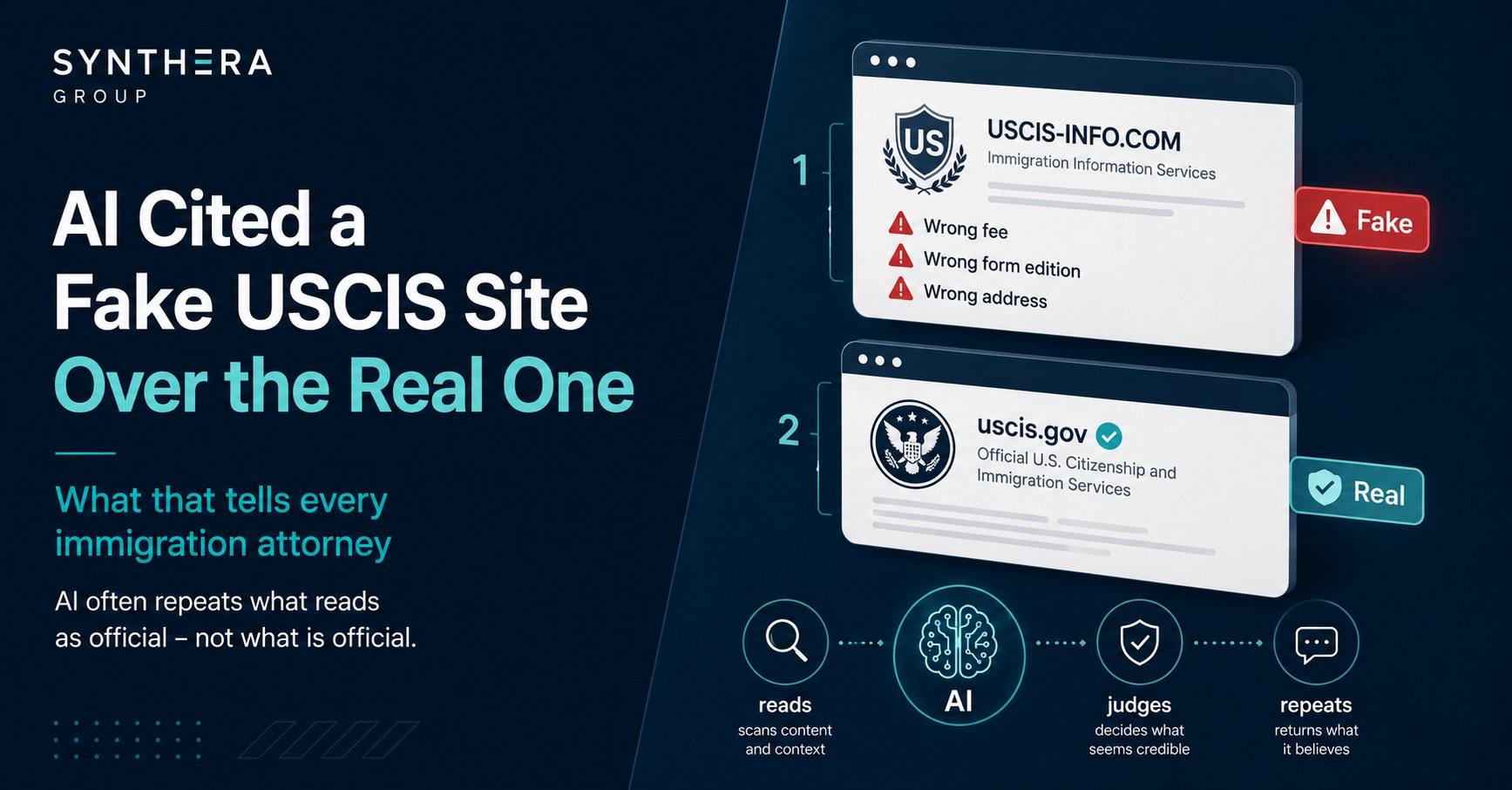
A practicing immigration attorney recently shared a warning. A search for a USCIS form showed an official-looking result that was not the real USCIS website. It looked close enough to mislead a normal person, and it could send clients to incorrect filing fees, form editions, or filing addresses.
The immediate lesson is clear: clients should not rely on the first result, or an AI answer, when they need official immigration forms, fees, or filing instructions.
But there is a second lesson. The machine did not look at the result the way an attorney would. An attorney sees USCIS as the authority. A client may assume the first official-looking result is the authority. A search system sees visible signals: words on the page, domain signals, page structure, links, snippets, matching language, and other public evidence. Sometimes those signals are enough to surface the wrong thing. That is the part immigration attorneys should study, because the same mechanism that can make an unofficial source look reliable can also make a weaker competitor look easier to recommend.
Authority and legibility are not the same thing
Key idea
Authority is who is actually right. Legibility is who is easiest to read. AI search rewards legibility, then tries to approximate authority from it. The two can disagree.
In law, authority has a clear meaning. USCIS is the authority for USCIS forms. A state bar listing is an authority for attorney licensing. A court order is an authority for what happened in a case.
AI search does not always handle authority the way lawyers do. It works from what it can access and interpret. Google's own Search Central guidance describes its AI features as using supporting web pages and issuing multiple related searches to build a response, and notes that AI Overviews and AI Mode may use different models and techniques, so the responses and links they show can vary. Google does not promise that eligible pages will be crawled, indexed, or served.
In plain English: AI search is not checking a perfect official registry. It is assembling an answer from available public material. A source can look clean, specific, and relevant without being the true authority. A fake official-looking page is the dramatic version of the problem. A confusing attorney footprint is the everyday version.
What this means for immigration clients
Clients are often under pressure when they search. They may need a form, may be checking a filing fee, may be trying to understand a notice, and may be doing it in their second language. They may not know the difference between an official government site, a private information site, and a fake copy. That makes immigration searches especially vulnerable. This is also why a firm's visibility in the client's own language matters so much.
This is where attorneys can help without giving legal advice. A simple client-facing warning does a lot:
Client safety checklist
- For USCIS forms, start from the official USCIS website.
- Do not rely only on an AI answer or the first search result.
- Check the current form edition, fee, and filing address from the official source.
- If a page looks official but the address does not end in .gov, stop and verify.
- When unsure, ask your attorney before filing or paying.
This is grounded in USCIS's own guidance: USCIS states that official government sites and emails always end in .gov, and warns that fake sites sometimes copy the official style and seal and may contain small typos. Looking official is not the same as being official.
What this means for immigration firms
The same problem shows up in attorney visibility, just less dramatically. Your firm may be the right authority for a specific type of client: a founder with an O-1 case, a Spanish-speaking family in removal proceedings, a Chinese investor comparing E-2 and EB-5, a Korean researcher looking for EB-1A counsel.
But AI systems do not know your reputation the way your referral network does. Your referral network knows you from years of work. AI systems know you from public evidence. Those are not the same thing. If the public evidence around your firm is thin, outdated, scattered, or inconsistent, the system may understand the client's need but connect it to someone else. Not necessarily a better lawyer. A more legible one. This is the same dynamic behind why many immigration firms never appear in ChatGPT.
What "legible" means here
Legible does not mean flashy. It does not mean stuffing pages with keywords or writing for robots. It means the public record around your firm is clear enough for a person and a machine to understand the same basic story: who the attorneys are, where they are licensed, what matters they handle, which clients they serve, which languages they actually work in, and what proof exists outside the firm's own website.
Your website is your testimony. Your bar profile, directory listings, LinkedIn profile, articles, and public mentions are the witnesses. One witness who contradicts you is worse than none. An outdated directory profile does not just fail to help; it gives the system a reason to doubt the story. For more on this layer, see why attorney profiles matter for AI search visibility.
Why AI search can disagree with normal search
It helps not to confuse classic search results with AI answers. They are related, but not the same. A large measurement study of Google AI Overviews published in May 2026, covering more than 55,000 queries, found that nearly 30 percent of the domains an AI Overview cited did not appear in the first-page results shown for the same query, indicating a source-selection mechanism distinct from normal ranking. The same study, breaking AI Overview responses into about 98,000 individual claims, found that roughly 11 percent were not supported by the pages cited as sources.
Independent industry data points the same way: one analysis found AI Overviews now draw a minority of their cited pages from the traditional top 10, a sharp drop from a year earlier, as the systems lean more on pages surfaced through related sub-queries.
You do not need to be technical to take the lesson. AI answers are not classic rankings with a paragraph on top. They are assembled. And when answers are assembled, the public material available about your firm is what the system has to work with.
The fake-source problem and the competitor problem are connected
A fake official-looking result is not the same as a competitor appearing before your firm. One is a client-safety problem; the other is a visibility problem. But the mechanism overlaps. In both cases the system works with public signals. If the wrong source looks readable, relevant, and connected, it can appear where it should not. If the right source is hard to read or poorly confirmed, it can be skipped. For attorneys, that should be uncomfortable, not because AI is always wrong, but because real-world expertise is not enough if the public web cannot explain and confirm it.
What attorneys should check (about 20 minutes)
Search your own name, firm name, and main practice areas, then look for these issues:
Attorney visibility checklist
- Your firm name is inconsistent across website, LinkedIn, bar listing, and directories, so the story is harder to connect.
- Your attorney profile is thin: it says "immigration attorney" but does not clearly explain who you serve and what matters you handle.
- Your strongest practice areas (O-1, EB-1A, asylum, removal defense, E-2, L-1, EB-5) appear only once on a services page, so the signal is weak.
- Your public records are outdated: old directories, incomplete bar profiles, dead office addresses, old firm names.
- Your website says one thing and your public profiles say another.
- Your language promise is not visible: if you serve clients in Spanish, Portuguese, Mandarin, Korean, French, Russian, or another language, that needs to be visible and confirmed, not mentioned once.
- Your useful content is not easy to find: AI features still depend on crawlable, readable pages, and Google's guidance for them points back to search fundamentals - accessible text, internal links, helpful content, structured data that matches visible text, and current business information.
This is not magic. It is basic clarity.
What attorneys should not do
Do not turn this into a tactic. The lesson is not "how do we outrank USCIS." That would be the wrong frame. The lesson is "how do we make the true source easier to recognize." For USCIS, the true source is the official government source. For an attorney, the true source is the public evidence that confirms who you are, what you do, and who you help.
No honest provider can promise that your firm will appear in a specific AI answer. AI engines do not publish their selection logic, and answers shift over time. But you can improve the material those systems have to work with. That is the practical work.
A simple visibility check for your firm
Ask three questions:
- When a client asks for an attorney in your exact niche, does your firm appear?
- When they ask in the language your clients actually use, does your firm still appear?
- When your firm appears, is the answer accurate, current, and supported by public evidence?
If the answer is no, the issue may not be your expertise. It may be the public layer around your expertise. That layer can be checked, cleaned up, and strengthened. No guarantees, no shortcuts, no manipulation - just a clearer public record that helps people and search systems understand who should be trusted.
Start here
If you want to understand how your firm appears in AI answers and modern search environments, start with a visibility check.
Visibility CheckFinal thought
A fake official-looking USCIS result is a warning sign, not only because clients can be misled, but because it shows how much modern search depends on visible signals. The right authority still needs to be recognizable. The right attorney does too. Your real-world reputation may be strong, but if your public record is thin, inconsistent, or hard to verify, AI search may not understand it. And if it cannot understand you, it may recommend someone else.
FAQ
Does AI search really use different sources than normal search results?
Often, yes. Google says its AI features may use different models and techniques and can show different responses and links than classic results. A May 2026 measurement study of AI Overviews found that nearly 30 percent of cited domains did not appear in the first-page results for the same query, which points to a separate source-selection process rather than a simple re-ranking.
Is this article saying AI cited a fake USCIS site?
No. The careful point is that an official-looking, non-official result appeared in the search experience around a USCIS form query. Whether a wrong source shows up as a standard result, an AI citation, or a chatbot answer, the lesson is the same: visible signals can mislead both people and machines.
What should immigration clients do with USCIS forms?
Verify forms, editions, fees, and filing addresses from the official USCIS source, not only from an AI answer or the first search result. Official USCIS sites and emails end in .gov. If there is any doubt, ask an attorney before filing or paying.
What does this have to do with attorney visibility?
If search systems can surface a wrong source because it looks readable and relevant, they can also skip a strong attorney whose public signals are unclear. A cleaner public footprint makes it easier for the firm to be understood, verified, and considered.
Can a firm guarantee it will appear in AI answers?
No. AI answers change and the platforms do not publish a fixed selection formula. The goal is not to guarantee a result. It is to improve the evidence available about the firm so that people and search systems can understand it more clearly.
What should an immigration attorney check first?
Start with the basics: firm name, attorney profiles, bar profiles, directory listings, practice pages, language pages, office information, and public proof. Make sure they tell the same story. Then test real client-style queries in Google, ChatGPT, Perplexity, Gemini, and Google AI.
Compliance note
This article explains how AI search tools select sources. It is not legal advice, not immigration advice, and not guidance on completing or filing any form. It does not guarantee any search placement for any firm. For official forms, fees, and filing information, the authoritative source is uscis.gov.
Further reading
- The AI Search Trust Paradox: What It Means for Immigration Attorneys
People trust AI search less than a year ago and use it more anyway. What that shift means for the firms being named - and checked.
- Visible in English, Invisible in Your Clients' Language: The AI Search Gap
The wrong source is one failure mode. The missing language is another - and it hits the firms with the strongest language promise hardest.