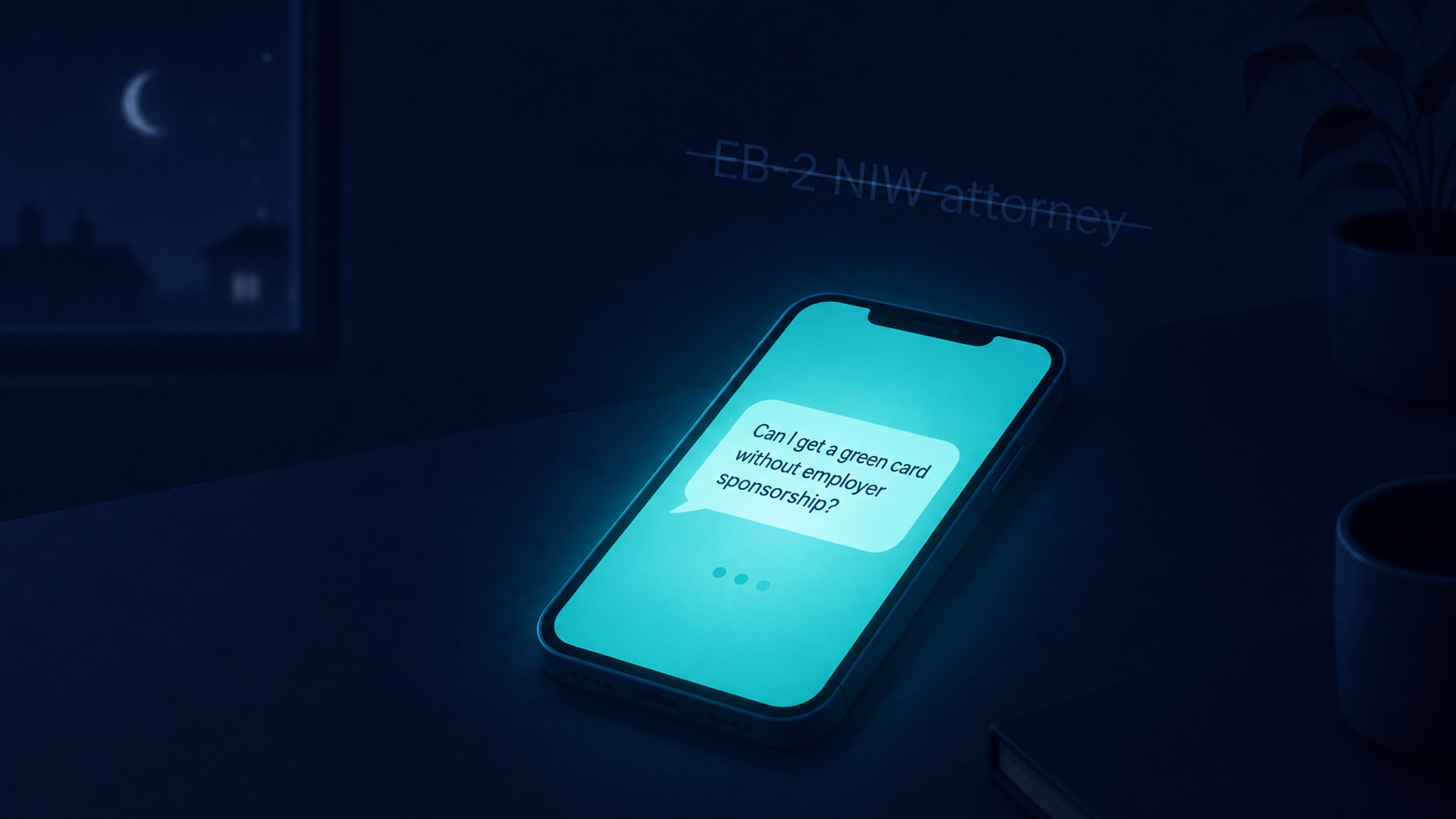
Most prospective immigration clients do not know the name of the visa they need. They describe their situation to an AI assistant in plain language, often in their first language, and the assistant returns a short list of firms. The firms that get named are the ones whose pages are written in the language of the client's question, not the language of the legal answer. If your site only speaks in visa codes, the person who needs you most never finds you, because they do not yet know the words you optimized for.
Picture a software engineer in Sao Paulo. Late at night, a US job offer on the table, a knot in the stomach. He does not open ten law firm websites. He opens one chat window and types, in Portuguese: "can I even move to the US with my job offer, and who do I talk to."
Notice what he did not type. He did not type "EB-2 NIW attorney." He does not know that phrase yet. That is literally what he needs a lawyer to figure out.
Most firm websites are written in the language of the answer. The client is asking in the language of the question. They pass each other in the dark.
Is your site written for the person who already knows the visa code, or the one who does not yet?
Why does the client ask AI before they ask a lawyer?
Because asking is now free, private, and immediate. A first conversation with a lawyer costs money, takes scheduling, and feels like a commitment before the person even understands their own situation. An AI assistant has none of that friction. So the first real consultation a prospective client has is not with a person. It is with a model, at midnight, in the language they think in.
By the time they reach out to a human, the shortlist already exists. The engineer in Sao Paulo will contact the two or three firms the assistant surfaced, not the forty that were technically available. The decision about who is in contention was made before you knew the person existed.
What language does a client actually search in?
The language of the problem, not the language of the solution. A client types "I have a job offer but no green card, what are my options," not "EB-2 NIW eligibility." They describe a life situation: a marriage, a job, a fear of being sent back, a child born abroad. The legal label is the output they are paying a lawyer to produce. Expecting them to know it before they hire you is backwards.
This gap is widest in the language segments where boutique firms have the most to gain. A Brazilian engineer asks in Portuguese. A family in Mexico City asks in Spanish. The assistant matches their question to firms that have stated, in crawlable form, that they serve that situation and that language. A firm whose entire site assumes the visitor already knows the visa code is invisible to the person who does not.
How does AI decide which firms to name?
It assembles an answer from what it can read and verify, then names a handful of firms that clearly match the situation described. Across repeated tests of immigration prompts in June 2026, the firms that appeared were consistently the ones who stated their niche and the client's language plainly on their own domain, and the firms that were absent were the ones whose strongest credentials lived only in a resume, a directory profile, or a bar listing the model does not treat as a match signal.
In other words, the model rewards the clear statement of who you serve, not the weight of the resume. A founder with twenty years of experience and a thin, jargon-heavy website can lose the placement to a newer firm that simply says, in plain language, what it does and for whom.
What does this mean for how your pages are written?
It means writing the page for the question, not only the answer. Every practice area needs a version of itself that a frightened, uninformed person would recognize as their own situation. The page that ranks for "EB-2 NIW attorney" is not the page that gets the engineer in Sao Paulo, because he never types that. The page that gets him answers the question he actually asks: can I move with this offer, and who helps me do it.
This is not about dumbing down. It is about meeting the client at the stage they are in. The legal precision still lives on the site, for the reader who is further along. But the front door has to be a sentence in the language of the problem, or the person who needs you most walks past a building they cannot see.
Frequently asked questions
Do clients really not know the name of the visa they need?
Most do not, at the start. People experience their situation as a life event, a job, a marriage, a deadline, a fear, not as a section of immigration law. Naming the correct category is part of the legal service they are seeking. A site that assumes the visitor already knows the term is written for the end of the journey, not the beginning where the choice of firm is actually made.
If AI builds the shortlist, is my website still worth anything?
It is worth more, not less, but in a different way. The website is now the primary thing the AI reads about you. Its job has shifted from persuading a human who already found you to being legible to a model that decides whether you are found at all. A clear, well-structured site is what puts you in the shortlist the client never sees being assembled.
Does this only matter for non-English speakers?
No. The same gap exists in English: clients ask whether their company can sponsor them, not about H-1B specialty occupation. Language segments simply make the gap more visible and more valuable, because fewer firms have stated their niche clearly in Portuguese or Spanish, so the firms that do stand out more sharply in the answer.
How would I know if AI names my firm?
Run the prompt yourself. Type the question a prospective client would actually ask, in their language, into ChatGPT or Perplexity, and see which firms come back. It is the single fastest way to see what a future client sees at the moment they choose. Most lawyers have never done it, which is exactly why the gap persists.
A note on how we work
This article describes patterns observed in repeated public tests of AI assistants and does not promise any specific search ranking, citation, or client outcome. AI systems change, and visibility in them cannot be guaranteed. Synthera Group works on the digital footprint and structure that make a firm legible to these systems, not on the outcome of any individual case or query.
If this is your firm
If you serve clients in a specific language or niche and you are not sure whether AI names you when they search, the first step costs nothing: see what the assistant says when someone describes your client's situation in their own words. If you want an independent read on that before deciding anything, that is where we start.