The best lawyer in the room is not the one who gets recommended
People do not pick the best lawyer anymore. They pick the one a machine can describe with confidence. An AI assistant behaves like a cautious party guest: it recommends the name it can say something sure about, and quietly skips the rest. If a machine cannot identify you in one clean sentence, your skill never enters the conversation.
I want to convince you of something that sounds wrong and then becomes obvious. The thing between you and your next good client is not your competence, your years, or your record. It is whether software can repeat who you are without hesitating. This is the first piece in a short series on how that software actually sees you.
The dinner party
Picture a dinner party. Someone says, "I need an immigration lawyer, my company is moving an engineer over from Brazil." A pause. Then a guest says, "Oh, you want the firm that only does extraordinary-ability cases for tech people. They are the ones for exactly this."
Notice what happened. The guest did not recommend the most decorated lawyer at the table. They recommended the one they could describe in a single confident sentence. The lawyer with thirty years and a vague reputation got skipped, not because anyone doubted her, but because nobody could finish the sentence "you want her because..."
An AI assistant is that guest, scaled to a billion conversations. It does not weigh your brilliance. It reaches for the name attached to a clear, repeatable description and says that one out loud. The quiet expert with the better record never comes up. Not rejected. Just never reached for.
Being known is not the same as being legible
We confuse two things that feel identical and are not. One is being known. The other is being legible.
A respected lawyer is known. Judges know her, past clients adore her, the courthouse regulars know her by name. All of that authority lives in human heads and in spoken word. A machine cannot hear any of it. It reads, and it only reads. So a wall of awards in a lobby is worth nothing to the system now making the shortlist, because the system cannot walk into the lobby.
Think of a brilliant musician who never recorded anything. Astonishing live, adored by everyone who was in the room, and completely absent from every playlist that decides what people actually hear today. The talent is real. The recording is missing. AI visibility is the recording, and most good firms simply never made one.
The passport and the business card
Here is the mechanism underneath all of this. Before an AI recommends a lawyer, it runs a quiet background check. It wants to see the same person, the same firm, the same credentials, in every place it looks. Website, bar profile, directory listings, LinkedIn. When those sources tell three slightly different stories, the machine does what a careful person does with a mismatched ID at the airport. It hands you back and waves through the traveler whose documents agree.
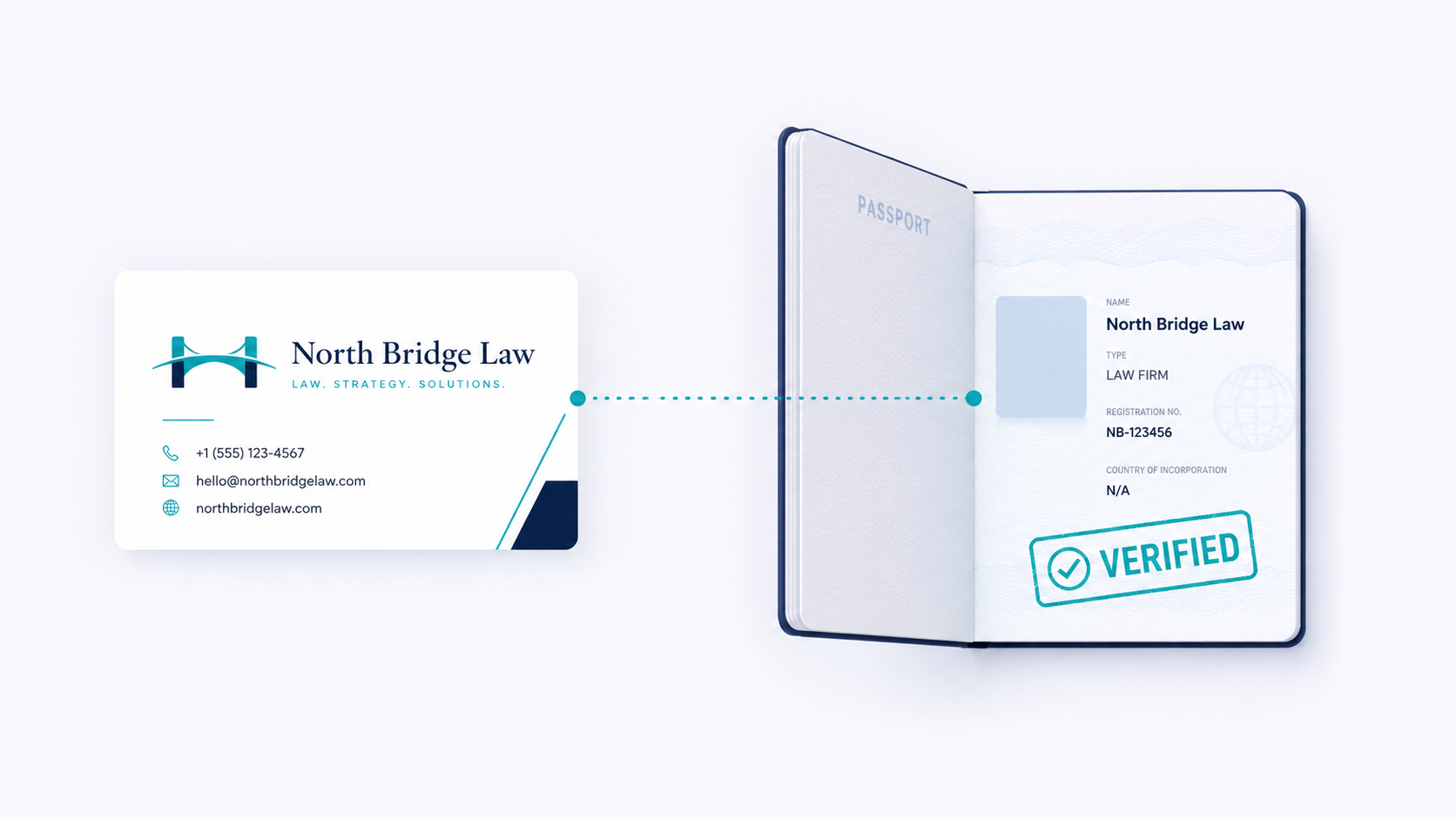
Your website is the business card. It states who you are. The machine wants the passport: the same identity confirmed in places you cannot quietly edit. A business card with no passport behind it does not get you through. It is not that the machine dislikes you. It cannot verify you, and an unverified name is a risk it declines to take in front of its own user.
Why "we handle all immigration matters" makes it worse
There is a deeper reason some firms read as a blur, and it is not technical at all. A firm that tries to be for everyone cannot be described in one sentence, and a thing that cannot be described in one sentence is invisible to a machine that only deals in descriptions.
"We handle all immigration matters" feels safe and inclusive. To a verification system it reads as static, a signal with no shape. The firm that says "we focus on extraordinary-ability cases for founders and senior professionals" hands the machine a clean, repeatable identity. Narrower is not smaller here. Narrower is legible, and legible is what gets recommended.
This is the strange inversion of the moment we are in. The signals that used to mean prestige, an old name, a broad practice, a distinguished vagueness, are the exact signals that make you invisible to the thing now doing the recommending.
There is a deeper reason firms end up this broad, and it is not laziness. It is that they never decided, out loud, who they are actually for. That is a positioning question, not a software one, and it is the subject of a companion piece: Anyone who needs a visa is the most expensive sentence on your website.
The good news hiding in the bad news
This should cheer you up rather than worry you. A quality problem is hard to fix; you cannot become a better lawyer by Friday. But this is not a quality problem. It is a legibility problem, and legibility is fixable fast, because the truth about you already exists. You are not inventing a story. You are writing down a true one in a form a machine can read and verify.
The lawyer who wins here is not the one who works hardest or knows most. It is the one a stranger who has never met them can describe in a single sentence. That sentence is buildable. Most of your competitors have not yet realised it is the whole game.
Common questions
Is this just SEO with a new name?
No. SEO decides where you rank on a page of results. This decides whether a machine can identify you at all, which happens one step earlier. You can be invisible here and rank nowhere, because you were never legible enough to enter the conversation.
I get plenty of referrals. Why should I care?
Because the party guest is being replaced by software for a growing share of first questions, and software cannot hear your referral reputation. You are not losing the clients who already know you. You are losing the ones who ask a machine first.
How fast does it change once fixed?
As a direction, over weeks, never as one clean snapshot. AI answers vary from day to day. You watch the trend across a month, the way you watch a tide rather than a single wave.
Disclaimer
This article is about marketing and visibility. It is not legal advice and makes no claim about the outcome of any legal matter.
A small invitation
Curious what an AI assistant actually says when asked to describe your firm today? I run a short Visibility Check that shows you the real answer, word for word. No pitch attached. Request a Visibility Check.